

Emerging Frontiers in Air Quality: A Synthesis on Submicron and Ultrafine Particles>>>
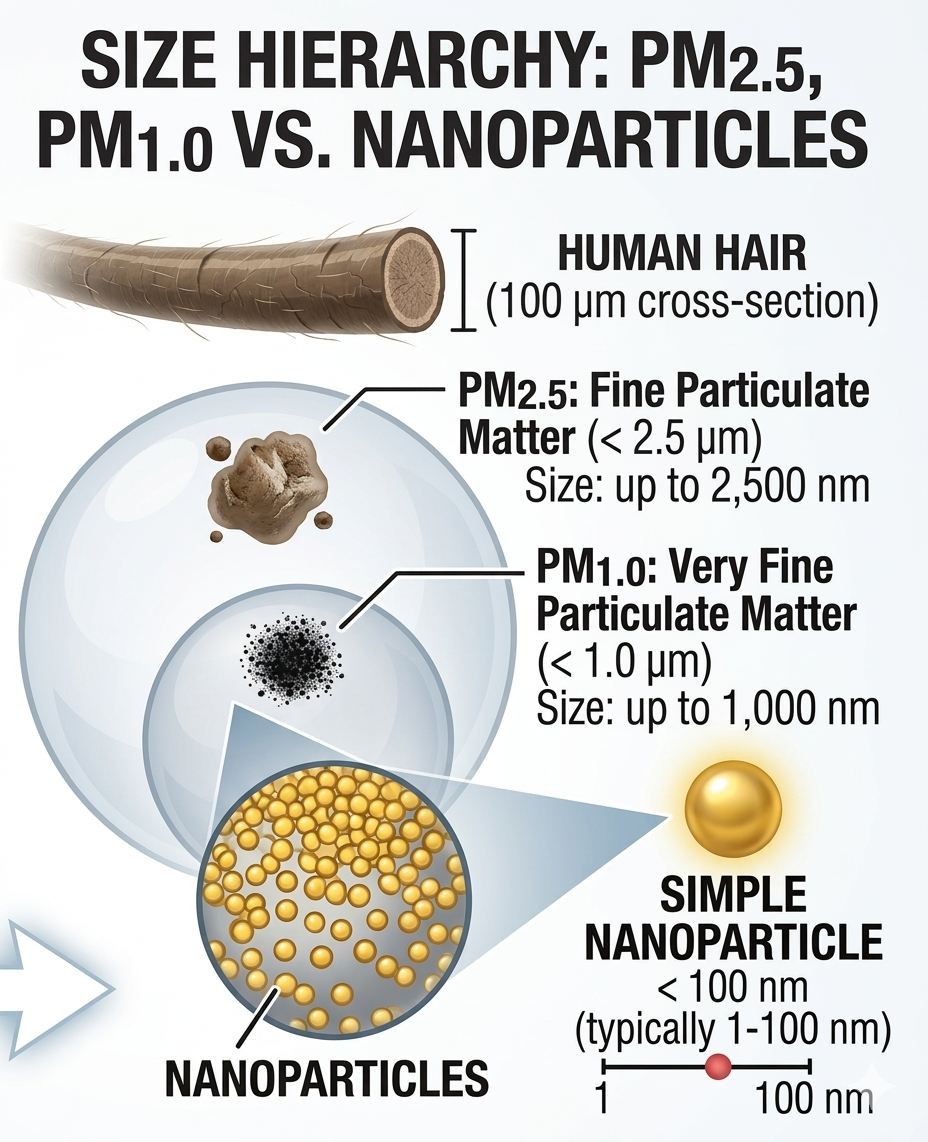
For decades, PM2.5 (i.e., particles of 2.5 microns and smaller) has been the gold standard for measuring indoor air quality (IAQ). However, recent research from the GOAQS Particulate Matter Working Group, summarized by Sotirios Papathanasiou, suggests that mass-based metrics may overlook the most severe physiological threats.
New data indicate that particle count and surface area—rather than just mass—are critical for understanding how pollutants interact with the human respiratory and circulatory systems.
1. Submicron Particles (less than 1 micron or μm)
Submicron particles are defined as having an aerodynamic diameter of less than 1.0 micron or μm.
While they are often grouped with PM2.5, their behavior and health impacts are distinct.
Expert Insights and Findings
Health Risk Profile: 95% of experts agree that particles at or smaller than 1 micron (PM1.0) are a superior indicator of health outcomes compared to PM2.5. Because these particles are smaller, they have a higher probability of penetrating deep into alveolar tissues and translocating into the bloodstream.
The Monitoring Debate: The expert group is split (47% vs 47%) on whether PM1.0 monitoring should be mandatory now or if further longitudinal study is required.
Technological Barriers: 42% of specialists note that while high-precision research tools exist, cost-effective and accurate sensors for consumer or routine commercial use are not yet widely available.
Standard Metrics: The preferred unit of measurement is particles per cubic centimeter (p/cm3), though some advocate for mass concentrations to stay compatible with current regulatory frameworks.
Recommended Research: Submicron Focus
Oxidative Stress: Barbier et al. (2023) highlighted how inflammation persists in lung tissue even after exposure to submicron particles ceases.
Real-time Assessment: Chou et al. (2025) utilized GED-ICP-MS to link trace metals directly to cancer risk.
Indoor Dynamics: Stratigou et al. (2022) provided frameworks for distinguishing between indoor-sourced and outdoor-penetrated submicron species.
2. Ultrafine Particles (UFP)
Ultrafine particles (UFPs) are smaller than 100 nanometers (nm). While they contribute almost nothing to the total “mass” of a sample, they often represent the vast majority of the “count.”
Key Challenges and Breakthroughs
Detection Gaps: Standard PM2.5 sensors often fail to detect particles smaller than 300 nm. This means significant spikes from 3D printers, laser printing, or indoor combustion (like woodsmoke) go entirely unnoticed by traditional monitors.
Physiological Impact: 74% of experts believe UFP counts provide a more precise health diagnostic. Their high Lung-Deposited Surface Area (LDSA) allows for greater chemical reactivity within the body.
Market Readiness: 53% of experts believe UFP technology is not ready for the mass market. Professional-grade monitors (e.g., CPCs or SMPS) typically cost between €5,000 and €15,000 (~$6,000-$18,000 USD as of 4-9-26).
Primary Sources: Research by Chen et al. (2024) and Chang & Hsiao (2026) emphasized the role of traffic-related emissions and indoor activities in urban microenvironments.
Essential Literature: Ultrafine Particles
Clinical Overviews: Schraufnagel (2020) and Kwon et al. (2020) provided foundational reviews of the unique physicochemical properties of UFPs.
Source Apportionment: Chen et al. (2023) explored how real-world driving conditions and “soft lockdowns” affect UFP distribution and toxicity.
Hospital Environments: Chang et al. (2023) investigated UFP dynamics specifically within operating rooms, highlighting the importance of air exchange rates.
References & Further Reading
Submicron Particles
Barbier, E., et al. (2023). Environment International, 181, 108248.
Chou, L. T., et al. (2025). Journal of Hazardous Materials, 138711.
Sotty, J., et al. (2019). Environmental Research, 176, 108538.
Stratigou, E., et al. (2020). Building and Environment, 186, 107357.
Ultrafine Particles (UFP)
Chang, P. K., & Hsiao, T. C. (2026). Journal of Hazardous Materials, 141024.
Chen, T. L., et al. (2023). Science of the Total Environment, 870, 161733.
Dimitroulopoulou, S., et al. (2026). New Perspectives in Indoor Air Quality, Elsevier, pp. 7-18.
Jung, C. R., et al. (2023). Environment International, 175, 1079.
Schraufnagel, D. E. (2020). Experimental & Molecular Medicine, 52(3), 311-317.
Digital Resources

Comments (0)