

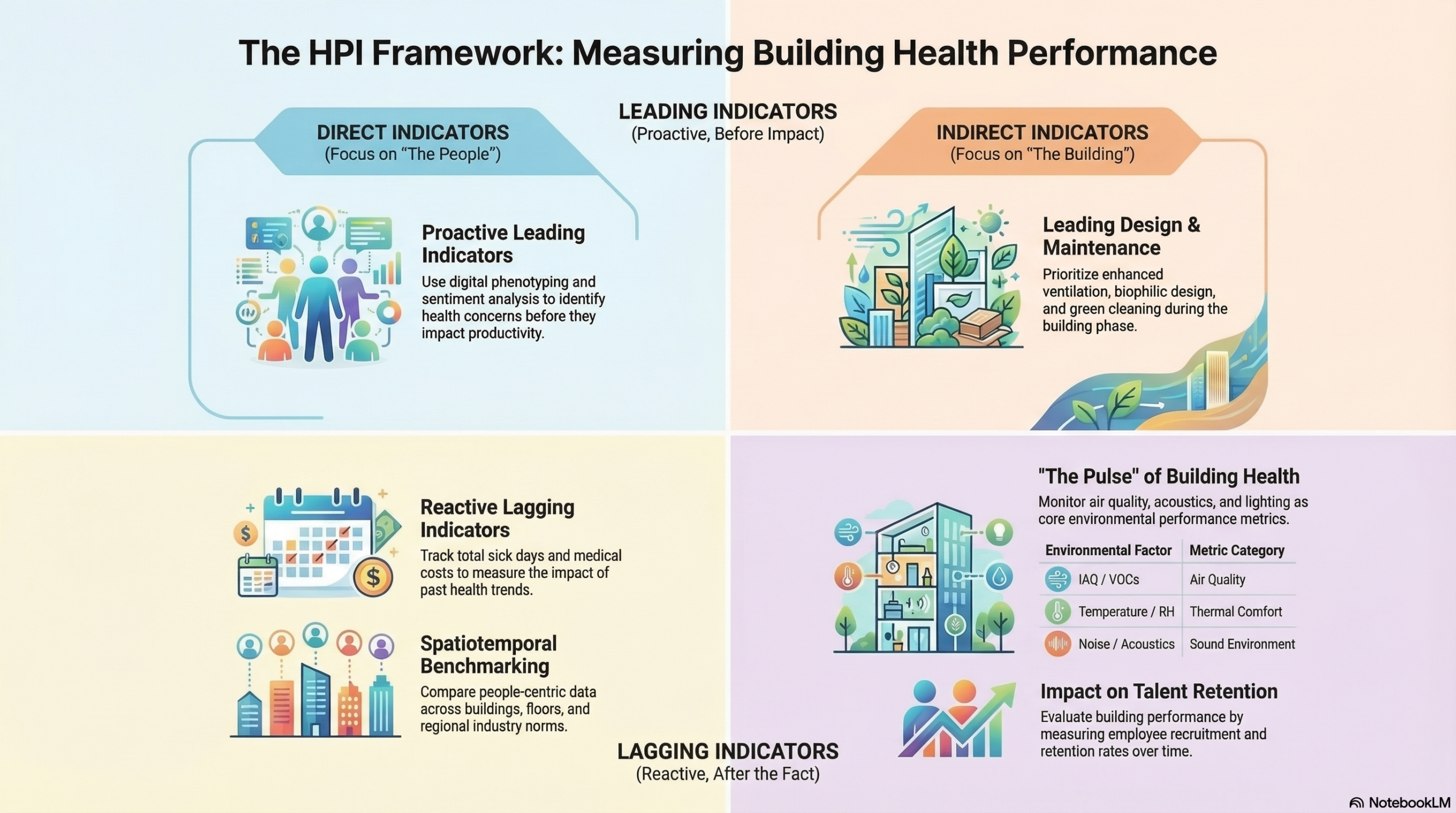
The Health Performance Indicator (HPI) Framework offers a comprehensive approach to evaluating the health performance of buildings by categorizing data into four distinct quadrants. Leading indicators focus on preventative measures, such as using digital sentiment analysis to gauge occupant well-being and implementing biophilic design during construction. Conversely, lagging indicators look at retrospective data, including employee sick days and staff retention rates, to assess the long-term effects of the environment. The system also emphasizes environmental metrics like air quality, acoustics, and temperature to monitor the physical state of the facility. By utilizing spatiotemporal benchmarking, organizations can compare these diverse data points across different locations and industry standards. Ultimately, this structured model helps businesses understand the vital link between architectural design, maintenance, green cleaning, and human health and productivity. Info and Chart derived from Healthy Buildings by Joseph Allen and John Macomber. Harvard University Press. 2022 – Kindle Edition.
Harvard Expert comments:
“This podcast does a super job of describing the main concepts of the COGfx study in easy to follow, conversational terms with good examples. It’s an excellent way to help listeners understand how indoor environmental quality can make you sick… or keep you well.” – John D. Macomber, a Senior Lecturer at Harvard, co-authored the landmark book, Healthy Buildings: How Indoor Spaces Drive Performance and Productivity (2022). The book presents a science-based business case for creating healthier offices, schools, and homes, arguing that indoor environments are the “first line of defense” for public health.
HEALTHY BUILDINGS: HOW INDOOR SPACES CAN MAKE YOU SICK–OR KEEP YOU WELL by Joseph G. Allen and John D. Macomber, Cambridge, Mass.: Harvard University Press, Copyright © 2020, 2022 by the President and Fellows of Harvard College. Used by permission. All rights reserved.