

By INDEX Editorial Team | Based on peer-reviewed research - When people think about indoor…
INDEX Supports WELL>>>
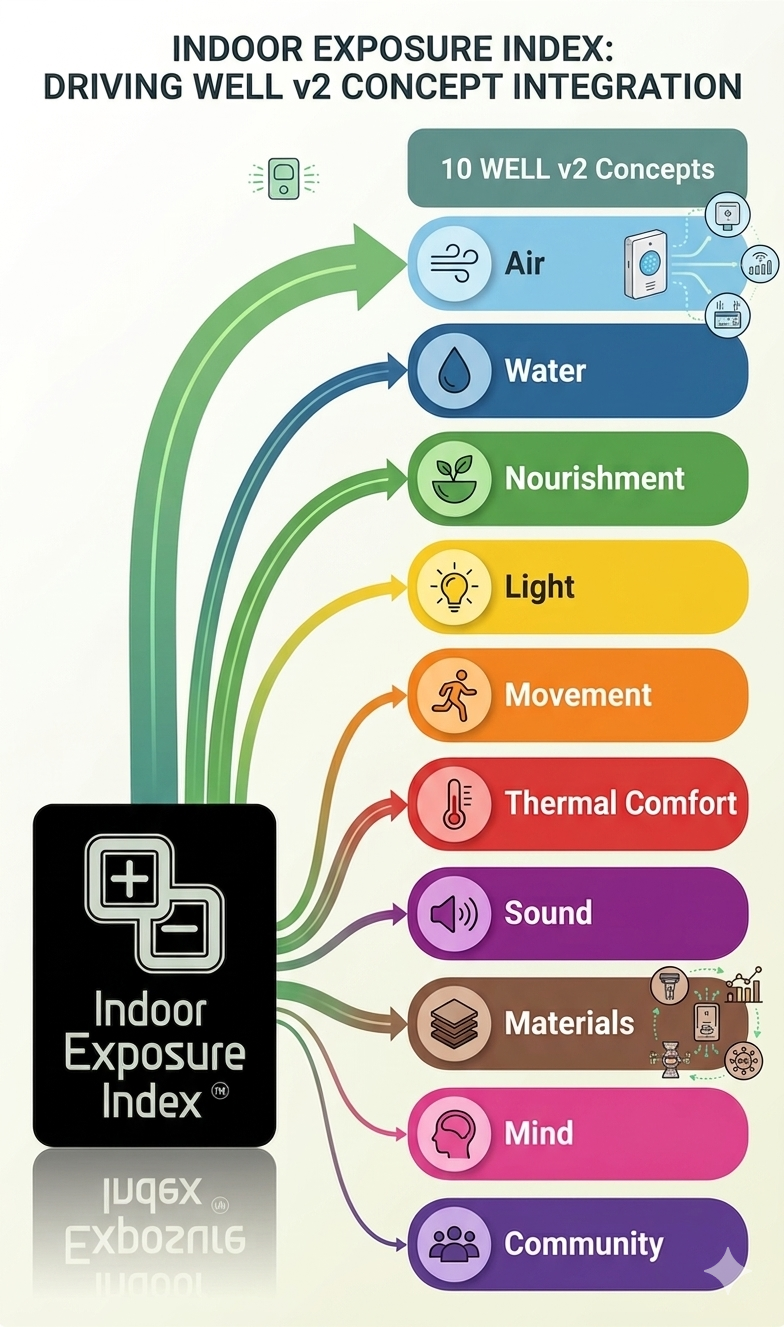
The Indoor Exposure Index formally supports the WELL standard.
The International WELL Building Institute (IWBI) is the public benefit corporation that oversees the WELL standard. Unlike LEED (which focuses on how a building treats the planet), WELL focuses on how a building treats the people inside.
The 10 “Concepts” of WELL v2:
- Air (Quality, point-of-use testing, filtration, smoke-free environments, other factors)
- Water (Quality, point-of-use testing, filtration, accessibility)
- Nourishment (Healthy food choices, labeling)
- Light (Circadian lighting, full-spectrum access, glare control)
- Movement (Ergonomics, exercise, active workstations, stair accessibility)
- Thermal Comfort (Zoned temperature control)
- Sound (Acoustic barriers, noise reduction, speech intelligibility)
- Materials (Reduction of toxic chemicals like formaldehyde or lead, optimization of other elements)
- Mind (Access to nature, mental health and emotional support)
- Community (Health benefits, diversity, social engagement, emergency preparedness)
The Indoor Exposure Index is an initiative designed to help the general public easily understand the various health hazards found within modern buildings — to protect and enhance health by managing exposures related to the core concepts of WELLv2. By translating complex technical data into a 360 standardized scale, this system empowers individuals to monitor pollutants and encourages companies to create safer indoor technologies. This index directly supports the WELL Building Standard, a comprehensive global framework that prioritizes human health over environmental impact. The WELL v2 system evaluates spaces across ten distinct categories to ensure buildings foster total well-being. Through performance testing and third-party verification, these standards transform scientific research into solutions. Together, these sources outline a growing movement to quantify and improve the biological and environmental quality of the places where people live and work.

Comments (0)