

This Healthy Buildings - Videocast is based on excerpts from the book: Healthy Buildings -…

Toolkit to Assess Indoor Air Quality (IAQ) >>>
These expert tips describe how to check your IAQ effectively and affordably. The total investment for equipment is approximately $200…
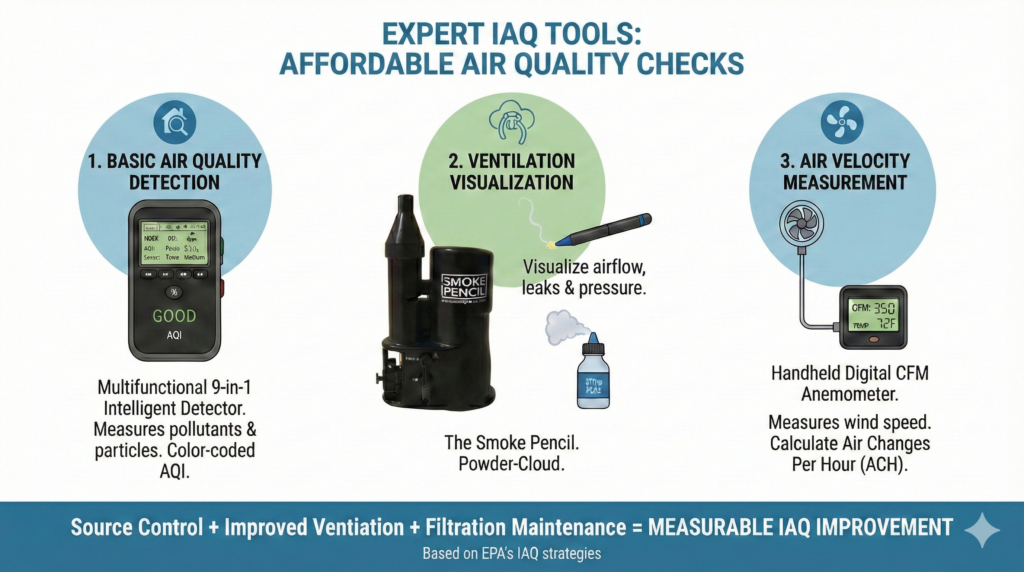
- Basic Air Quality Detection (Screening)
Tool: Multifunctional (9-in-1) Intelligent Detector
Estimated Cost: ~$60
Purpose: To establish baseline comfort and IAQ levels and identify potential health hazards.
Key Features:
• Target Parameters: Measures temperature, humidity, Formaldehyde (HCHO), Total Volatile Organic Compounds (TVOCs), Carbon Monoxide (CO), and Carbon Dioxide (CO2).
• Particulate Matter: Monitors PM2.5 (fine particles <2.5 µm) and PM10 (dust, pollen, and mold <10 µm) to help identify pollutant origins and filtration efficacy.
• Air Quality Index (AQI): Look for units with color-coded AQI displays to easily communicate health concerns to clients.
• Methodology: Take measurements of outdoor air and non-trafficked indoor air to establish a background pattern for comparison. - Ventilation Visualization (Airflow & Leaks)
Purpose: To “see the invisible” by observing air currents, pressure gradients, and potential cross-contamination pathways.
• The Smoke Pencil (Fog Generator)
o Cost: <$70
o Use Case: Large spaces (classrooms, kitchens, gyms) and verifying isolation rooms or biological safety cabinets.
o Mechanism: Uses non-toxic glycerin “fog juice” and laser lighting for visibility in dark spaces.
• The Smoke Pen
o Cost: <$50
o Use Case: Small-scale leak detection, drafts, furnace exhausts, and kitchen hood effectiveness.
o Mechanism: A pocket-sized tool with a lighted wick that produces dense, low-odor smoke for ~30 minutes.
• Powder-Cloud Puffer
o Cost: <$50
o Use Case: Low airflow conditions.
o Mechanism: Uses fine Borozin powder (zinc stearate), which remains visible in the air longer than smoke. - Air Velocity Measurement
Tool: Handheld Digital CFM Anemometer (Impeller)
Estimated Cost: <$50
Purpose: To measure wind speed and temperature to calculate air turnover rates for compliance with ASHRAE standards.
Application:
• Measure velocity at air intakes and exhausts.
• Calculate Air Changes Per Hour (ACH) using the formula:
ACH = (CFM x 60)/room volume.
Summary
By using these three types of tools—detection, visualization, and measurement—practitioners can gain measurable insights into the EPA’s three strategies for IAQ improvement: source control, improved ventilation, and filtration maintenance.
For more information, contact powitz@sanitarian.com

Comments (0)