
This Healthy Buildings - Videocast is based on excerpts from the book: Healthy Buildings -…
Insights on Near Infrared Light – and Benefits >>>
Below is a summary of an open-access research paper from Nature.com posted by the 501(c)(3) Science of Light re: common LED lighting, near-infrared light, human health and vision.

The Problem: “Malnourished” Light…
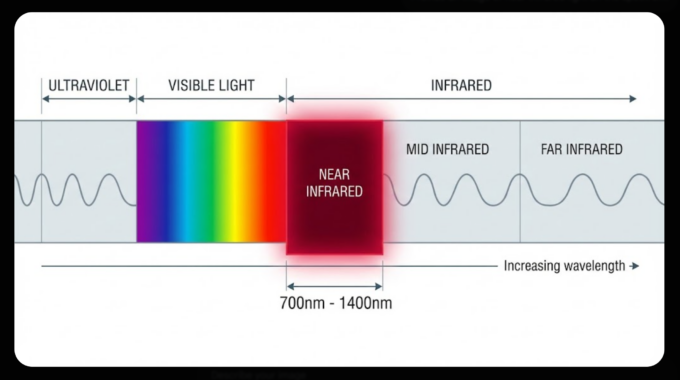
Life on Earth thrives under sunlight, which contains a broad mix of colors, ranging from invisible ultra violet and visible light to invisible infrared energy. However, many modern energy-saving and often-inexpensive LED lights strip away the infrared and deep red parts of the spectrum, delivering only a narrow band of blue and yellow light.
The researchers argue this “restricted” diet of light harms our cells. Specifically, the mitochondria (the power plants of our cells) rely on longer wavelengths like deep red and infrared to produce energy efficiently. Without these wavelengths, cellular batteries run low, which can impair function and health.
Learn more about malnourished light.
The Experiment: Adding the Missing Light
To test this theory, scientists conducted a study in an office building where employees worked under standard LED lights with no natural daylight.
The Intervention: For two weeks, the researchers placed simple incandescent desk lamps (old-fashioned bulbs that produce heat/infrared) on or over the workers’ desks to “supplement” the lighting.
The Test: They measured the workers’ “color contrast sensitivity”—essentially how well their eyes could distinguish letters against a noisy background.
The Control: A separate group of workers stayed under only common LED lights to serve as a comparison.
The Results: A Lasting Vision Boost
The creation of broader-spectrum light by combining the two sources produced significant results:
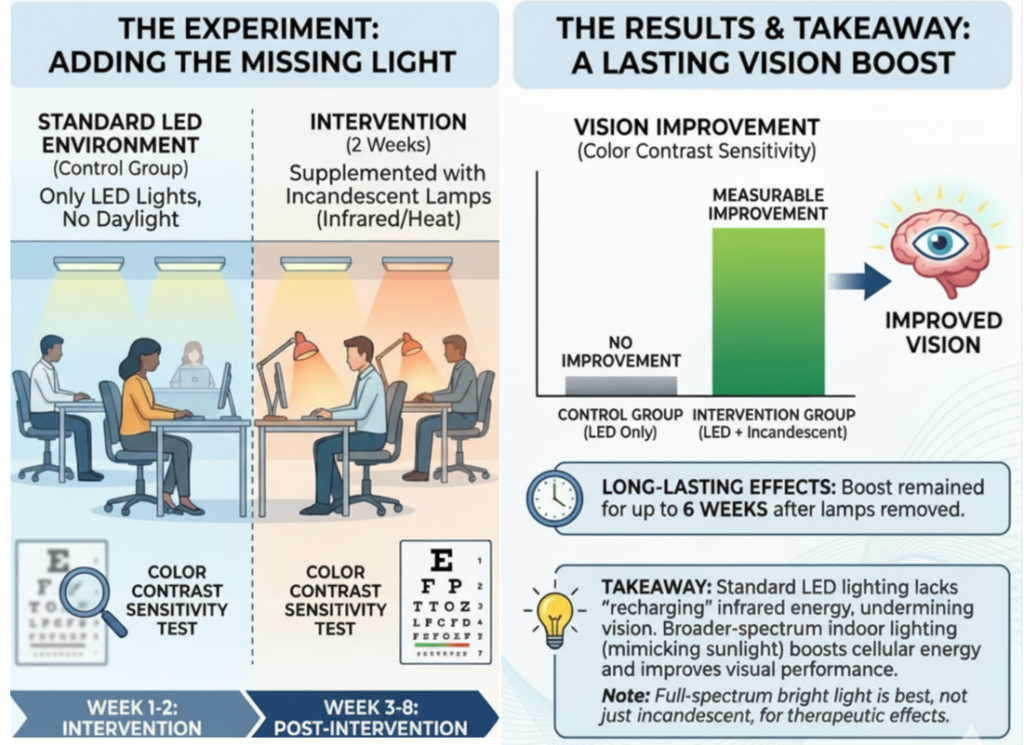
Vision Improved: Workers exposed to the incandescent lamps saw a measurable improvement in their ability to detect color contrast. [This is not to imply that incandescent bulbs are the answer, but just that the near-infrared provided is missing from common LED lighting. True full-spectrum “bright” lighting, not incandescent light, is best as it’s closet to natural sunlight, but without the harmful UV of unfiltered sunlight. Ordinary incandescent lighting alone is usually too dim to serve as therapeutic “bright” light.]
Long-Lasting Effects: The visual boost remained for up to six weeks after the researchers removed the lamps.
Controls Stayed the Same: The workers who remained under only LED lights showed no improvement.
The Takeaway
Standard LED lighting, while energy-efficient, may undermine human visual performance because it lacks the “recharging” energy of infrared light. Supplementing indoor lighting with broader spectra—similar to natural sunlight—boosts cellular energy in the retina and significantly improves vision.

Comments (0)